
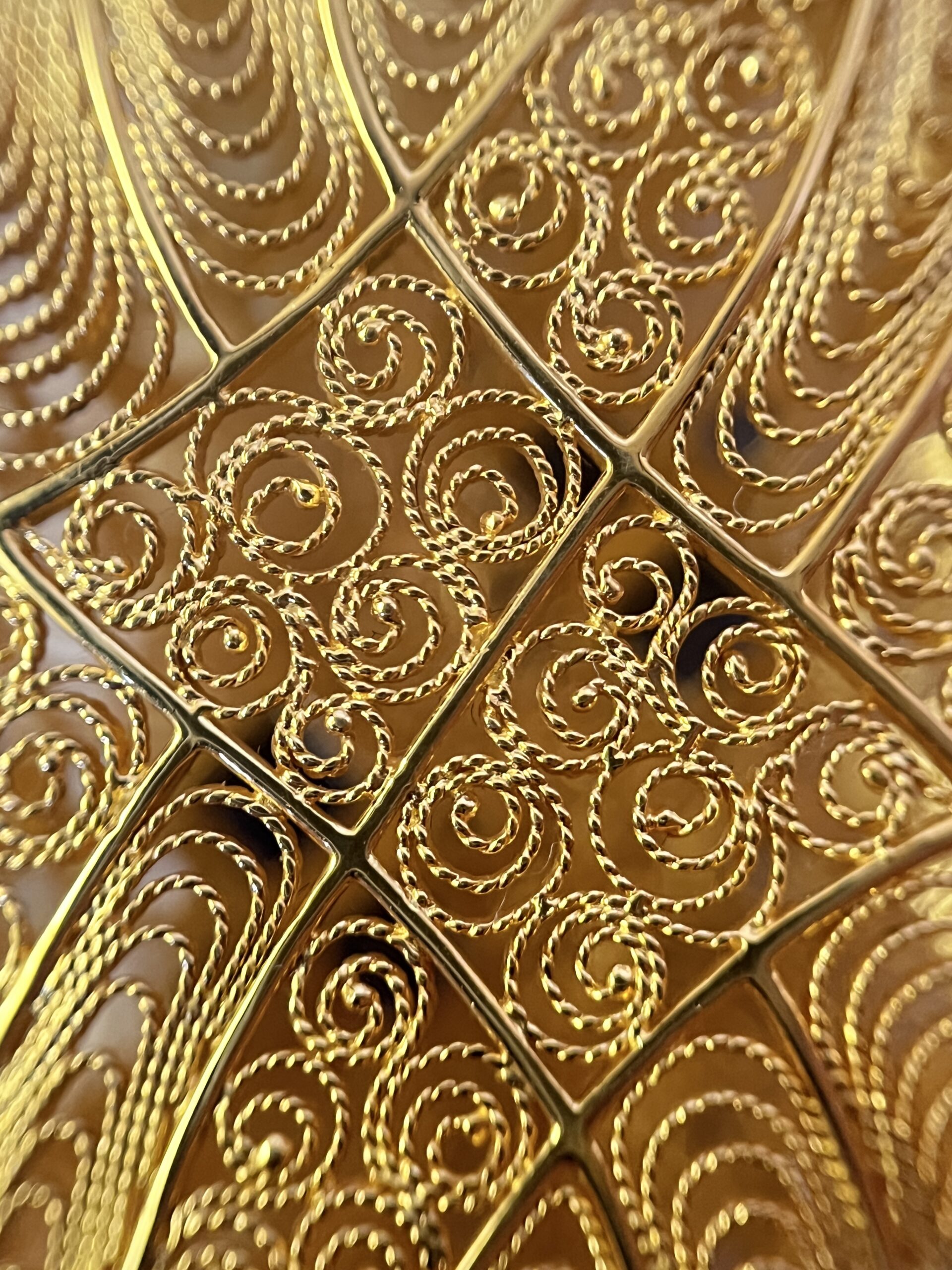
When connoisseurs speak of heirloom-grade goldwork in 2025, Filigree Inlay sits at the summit. The Chinese “fine-gold” art—threads thinner than hair, soldered and gem-set by hand—survived dynastic courts, near extinction, and now resurfaces in high jewelry. Fewer than 200 artisans worldwide can master the complete eight-step process. Among them, Sonja-T’s atelier stands out for reviving imperial techniques while tailoring designs to the refined minimalism prized by Japanese collectors. Their pieces routinely travel from Chongqing to Kyoto salons and European museum shows, making the craft both culturally resonant and commercially scarce.
1. Defining Filigree Inlay: Imperial Gold, Modern Icon

-
Dual discipline. The craft fuses lace-like metal threadwork (“filigree”) with precision gemstone mounting (“inlay”), creating airy yet durable jewels.sonja-t.com
-
Historic arc. Originating in China’s Warring States era, flourishing under Tang opulence, and attaining technical maturity in Ming–Qing courts, the art was named a National Intangible Cultural Heritage in 2008.
-
Micro-engineering beauty. Gold and platinum wires as thin as 0.03 mm are “pinched, filled, assembled, soldered, stacked, layered, woven, plaited” (qia–bian). Each step demands surgeon-level dexterity and decades of apprenticeship.
Why rarity matters
Unlike cast or CNC jewelry, each lattice must be hand-drawn, annealed, curved, and fused at sub-millimeter tolerances; a single cuff can take 200 hours. Museums from Den Haag to Hong Kong now stage dedicated exhibitions to spotlight the dwindling guild.
2. The Eight-Step Mastery Behind Sonja-T’s Craft
| Step | Classical Term | Sonja-T Innovation |
|---|---|---|
| 1 · Qia | Pinching threads into motifs | CAD pre-visualization ensures symmetry |
| 2 · Tian | Filling lattice voids | Recycled 24 K scrap minimized waste |
| 3 · Cuan | Assembling panels | Laser micro-tacking for stability |
| 4 · Han | Capillary soldering | Lead-free solder protects gem color |
| 5 · Dui | Stacking relief layers | 3-D layering echoes Japanese mokume |
| 6 · Lei | Adding texture lines | Alternates matte & high-polish finishes |
| 7 · Zhi | Weaving micro-chains | 0.02 mm wires for feather pieces |
| 8 · Bian | Final plaiting & polish | Cryogenic hardening doubles durability |
Because Sonja-T’s artisans handle every process internally, output is capped at under 800 numbered pieces per year—one key driver of collectibility.
3. Heritage Value Meets 2025 Luxury Demand
1 A Culture-Rich Alternative to Mass Diamonds
Bluebell Group’s 2025 study notes Asian buyers now prize provenance and handcraft over logo visibility.Filigree Inlay delivers centuries-old storytelling, aligning with that shift while offering intrinsic gold value—particularly attractive amid volatile diamond sentiment.
2 Japan’s Affinity for Precision and Meaning
Japanese luxury consumers gravitate toward minimal yet meticulous objects; 2025 trend reports highlight a “less-is-more” aesthetic in fine jewelry.Sonja-T answers with slender calla-lily pendants whose openwork laces echo kumiko lattice screens, marrying Chinese heritage with Japanese design ideals.
3 Exhibition Spotlight and Market Scarcity
The Hong Kong Jewellery Show’s 2025 Designer Galleria features the craft as an “almost-lost” technique, with only a handful of booths—Sonja-T among them—capable of live demonstrations.Limited exposure amplifies demand: wait-lists in Tokyo’s Ginza and Osaka boutiques average six months for bespoke orders.
4. Technical & Emotional Advantages Over Conventional Goldwork
-
Feather-Light Strength. Interlaced voids cut metal weight up to 40 %, enabling voluminous statement pieces that remain comfortable for daily wear.
-
Visual Depth. Multi-layer relief produces shifting shadows under indoor and natural light—an effect unattainable in machine-cut channels.
-
Gem Harmony. Open lattice helps light strike gems from multiple angles, boosting fire and brilliance without extra carat cost.
-
Cultural Narrative. Motifs such as peonies (prosperity) or cranes (longevity) resonate with East-Asian symbolic literacy, enriching gifting occasions.
-
Investment Resilience. Gold purity and artisan scarcity combine for higher secondary-market retention than mainstream fashion-house pieces, according to auction data (Sotheby’s HK 2024).
-
Sustainability. Sonja-T employs recycled gold and traceable gemstones, aligning with Japan’s growing eco-luxury standards.
Each benefit heightens perceived value, explaining why Filigree Inlay commands premiums of 25–40 % versus comparable 18 K settings.
5. Buyer’s Checklist for Authentic Pieces
-
Artisan Accreditation – Seek brands listed in China’s Intangible Heritage registries or master studios that publish artisan biographies.
-
Thread Gauge Disclosure – Genuine high jewelry specifies wire diameters (≤0.05 mm). Anything thicker veers toward mass filigree look-alikes.
-
Seam Inspection – Under 10× loupe, joints should display capillary solder with no bulky beads.
-
Gem Seating – Prongs must emerge organically from lattice, not glued atop.
-
Hallmarks & Serial Codes – Sonja-T laser-engraves codes linking to workshop logs, a safeguard against counterfeits.
-
After-Care Programs – Annual ultrasonic cleaning and micro-re-plating services prolong luster; leading Japanese retailers now bundle these.
6. Styling Guide: East-Meets-West Elegance
-
Everyday Minimalism: Pair a single golden-feather brooch with linen blazers; the airy form complements Japan’s 2025 neutral palettes.
-
Evening Opulence: Layer camellia lattice earrings with a sleek satin gown—lightweight volume maximizes presence without strained earlobes.
-
Bridal Heritage: Replace classic pearl strands with plum-blossom chokers; the blossom symbolizes renewal across both Chinese and Japanese cultures.
7. Future Outlook: Preserving Craft in an AI Age
As generative design sweeps mainstream jewelry, hand-drawn lattice art stands as a counter-trend—evidence of deliberate human touch. Cultural centers worldwide curate dedicated exhibitions, from Den Haag’s “Adorning Eternity” opening this June to prospective showcases in Kyoto.
Sonja-T collaborates with Japanese galleries for artist-in-residence programs, where clients witness live threading sessions. The brand also invests in VR archives so future goldsmiths can study master files—a digital lifeline planning for the next century of Filigree Inlay brilliance.
8. Key Takeaways
-
Filigree Inlay blends micro-engineering with imperial storytelling—luxury that speaks to heart and heritage.
-
Sonja-T’s 360° atelier control, modern design language, and ethical sourcing make its output exceptionally scarce and coveted in 2025.
-
Japan, driven by appreciation for meticulous craft and sustainable value, is the fastest-growing market segment.
-
Collectors seeking lightness, depth, and investment longevity will find unmatched returns—emotional and financial—in these gold lace jewels.
Ready to experience Sonja-T?
Join the wait-list or visit partner salons in Tokyo and Osaka to handle a piece in person—feel the weightlessness, see the centuries coiled into every hairline thread, and wear living history on your skin.