
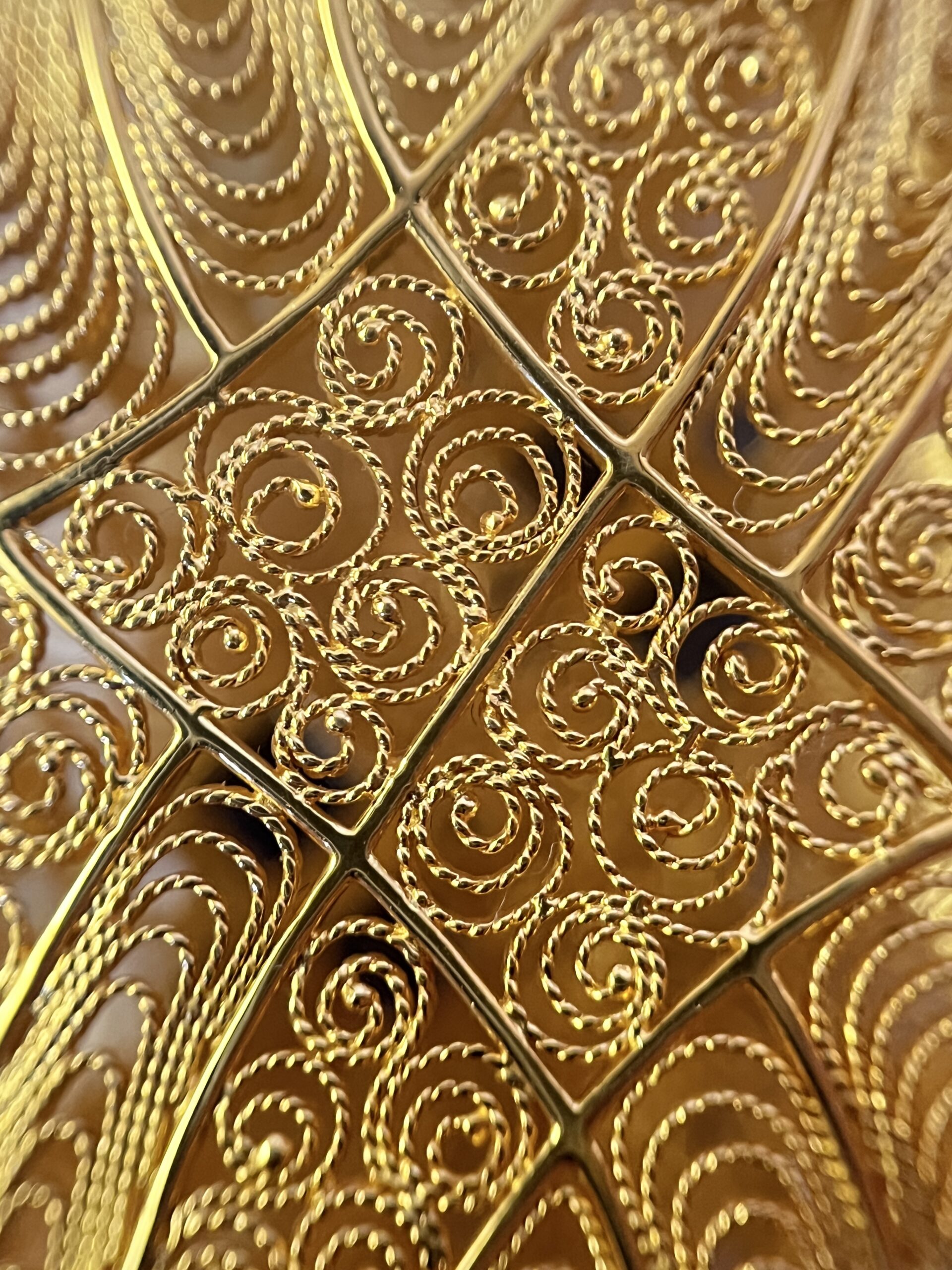
When Tokyo stylists speak of jewelry that “floats” instead of hangs, they point to Filigree Inlay earrings—hair‑thin gold threads woven into airy lace that barely tips the scale yet turns every head. In 2025, these lattice creations have eclipsed chunky hoops and statement studs among Japan’s minimalists, who prize comfort, cultural resonance, and quiet prestige. A nationwide consumer survey even lists “weightless feel” as a top buying factor for earrings, ahead of carat count or logo visibility.
1. Feathers of Gold: The Essence of Filigree Inlay
Born in China’s imperial courts, this craft draws 24 K gold down to 0.03 mm wire—one‑third a human hair—then bends, solders, and layers it into openwork mosaics. Because as much as 60 % of the surface is negative space, light ricochets through the lattice, illuminating skin as much as metal. Sonja‑T, today’s flagship atelier, limits output to under one thousand pair a year, each serialized and documented on its website.
2. Lightness as Luxury: The Japanese Minimalist Perspective
Japan’s luxury buyers have long equated beauty with effortlessness—think kimono silk that “whispers” or porcelain teacups thin enough to glow. Earrings follow the same code. Academic trials on wearable tech note that participants rank weight as the most critical comfort metric for ear accessories. Thus a lattice earring weighing under a gram aligns perfectly with national tastes that value subtlety over spectacle.
3. Engineering Weightlessness: How the Lattice Works
Each Sonja‑T earring begins with a CAD preview but ends under a loupe and torch. Open ribs cut metal mass nearly in half while cryogenic hardening raises tensile strength by 20 %. The result: pieces that feel like air yet survive daily subway commutes and typhoon‑season humidity. This structural paradox—delicate but durable—is why collectors view the earrings as technological art, not just adornment.
4. Design Harmony: Motifs, Lines, and Wabi‑Sabi Spaces
Wabi‑sabi aesthetics cherish the imperfect and impermanent; the shifting negative space inside a Filigree Inlay spiral embodies that creed. Popular motifs include bamboo (resilience) and breeze‑blown grass (transience), both rendered with asymmetrical curves that feel organic against the jawline. Pastel sapphires or Akoya pearls—2025’s top Japanese gem trend—often punctuate the gold, adding a quiet shimmer without visual heft.
5. Comfort Meets Culture: Everyday Wear in Tokyo and Beyond
Minimalists demand jewelry they can forget until a mirror reminds them. Feather‑light lattice distributes pressure so evenly that even extended mask loops or wireless earbuds cause no tug. Meanwhile, cultural symbolism—cranes for longevity, plum blossoms for renewal—turns each pair into a personal talisman, resonating during rites like Seijin‑no‑Hi or a simple afternoon omakase.
6. Market Pulse 2025: Demand, Pricing, and Limited Editions
Japanese e‑commerce data show searches for “lightweight heritage earrings” rising 28 % year‑on‑year, with Ginza boutiques reporting waitlists for Sonja‑T drops.Prices track scarcity rather than gram weight: a 0.9 g lattice stud can outprice a 4 g solid‑gold hoop by 30 %, reflecting hours of handwork and certified provenance. Auction houses now dedicate special lots to the technique, signalling strong secondary‑market traction.
7. Selecting Your Pair: Expert Tips from Sonja‑T
-
Match Motif to Message – Bamboo for resilience, chrysanthemum for grace.
-
Consider Gem Interaction – Pale jade softens yellow gold; ruby ignites it.
-
Test the Balance – Gently shake the earring; a true lattice piece will stay centered without swinging like a pendulum.
-
Ask for Serial Documentation – Authentic studios provide QR‑linked craft logs, useful for insurance and resale.
8. Key Takeaways on Lightness and Legacy
-
Filigree Inlay earrings unite imperial craft with weightless comfort, echoing Japan’s taste for understated luxury.
-
Negative‑space engineering delivers feather feel while preserving structural strength.
-
Cultural motifs and ethical sourcing elevate the pieces beyond fashion into heirloom territory.
-
Demand is climbing, driven by minimalists who see value in refinement rather than volume.
Slip a pair on, and you might forget they’re there—until someone asks where you found jewelry that looks like sunlight woven into air.